 极客教程
极客教程如何使用Express实现文件上传和下载
文件上传和下载是Web应用的重要功能。在这里,我们将使用 express-fileupload npm 包来处理文件上传,并使用 express 的 res.download() 函数来处理下载。 express-fileupload 将作为中间件传递给应用程序。
实现方法: 首先,安装 express-fileupload 模块,然后将其导入并作为中间件传递给应用程序,如下所示:
const fileUpload = require('express-fileupload')
app.use(fileUpload())
然后,要在POST请求中访问已上传的文件,可以使用:
req.files.<uploaded_file_name>
它提供一些函数和值,如文件名、mime类型、数据和大小。它提供了一个重要的 mv() 函数,用于保存上传的文件。它以上传路径和错误处理函数作为参数。
req.files.<uploaded_file_name>.mv(<upload_path>, function(err) {
  // statement(s)
})
下载使用 res.download() 函数处理,该函数接受两个参数:文件路径和错误处理函数。
res.download( <file_path>, function(err) {
  // statement(s)
})
上传和下载的实现:
步骤1: 创建一个 app.js 文件, index.html 文件,并使用以下命令初始化项目:
npm init
步骤2: 使用以下命令安装express和express-fileupload:
npm install express
npm install express-fileupload
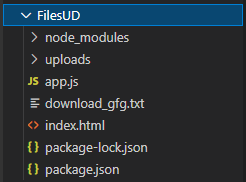
项目结构: 项目结构将如下所示。在项目目录下创建一个名为upload的文件夹,并在项目文件夹内创建一个名为download_gfg.txt的文件,该文件将被下载。
步骤3: 现在我们首先来编写 index.html 文件。在其中,我们创建了两个表单,一个处理上传,具有 action=’/upload’ ,另一个处理下载,具有 action=’/download’ 。
index.html
<!DOCTYPE html>
<html lang="en">
<head>
    <meta charset="UTF-8">
    <meta http-equiv="X-UA-Compatible"
          content="IE=edge">
    <meta name="viewport"
          content="width=device-width, initial-scale=1.0">
    <title>Files</title>
</head>
<body>
    <!-- Upload section-->
    <div>
        <h3>Upload Section</h3> <br>
        <!-- action to the /upload route-->
        <form action="/upload"
              method="post"
              enctype="multipart/form-data">
            File to be uploaded: <input type="file"
                                        name="uploadFile"
                                        id="">
            <br><br>
            <button type="submit">Upload</button>
        </form>
        <br>
    </div>

    <!-- Download Section-->
    <div>
        <h3>Download Section</h3> <br>
        <!-- action to the /download route-->
        <form action="/download" method="get">
            <button type="submit">Download</button>
        </form>
    </div>

</body>
</html>
步骤4: 现在我们将编写 app.js 文件。在其中,我们创建了一个 POST 路由 – ‘/upload’ 来处理上传,并且创建了一个 GET 路由 – ‘/download’ 来处理下载。对于应用程序的根目录的 GET 请求,我们发送 index.html 文件。
app.js
// Requiring express to handle routing
const express = require("express");

// The fileUpload npm package for handling
// file upload functionality
const fileUpload = require("express-fileupload");

// Creating app
const app = express();

// Passing fileUpload as a middleware
app.use(fileUpload());

// For handling the upload request
app.post("/upload", function (req, res) {

  // When a file has been uploaded
  if (req.files && Object.keys(req.files).length !== 0) {

    // Uploaded path
    const uploadedFile = req.files.uploadFile;

    // Logging uploading file
    console.log(uploadedFile);

    // Upload path
    const uploadPath = __dirname
        + "/uploads/" + uploadedFile.name;

    // To save the file using mv() function
    uploadedFile.mv(uploadPath, function (err) {
      if (err) {
        console.log(err);
        res.send("Failed !!");
      } else res.send("Successfully Uploaded !!");
    });
  } else res.send("No file uploaded !!");
});

// To handle the download file request
app.get("/download", function (req, res) {

  // The res.download() talking file path to be downloaded
  res.download(__dirname + "/download_gfg.txt", function (err) {
    if (err) {
      console.log(err);
    }
  });
});

// GET request to the root of the app
app.get("/", function (req, res) {

  // Sending index.html file as response to the client
  res.sendFile(__dirname + "/index.html");
});

// Makes app listen to port 3000
app.listen(3000, function (req, res) {
  console.log("Started listening to port 3000");
});
运行应用的步骤: 使用以下命令启动应用程序。
node app.js
输出: 打开浏览器,然后转到 **http://localhost:3000/, ** 您将会看到以下命令: