 极客教程
极客教程Java中的反向优先队列
当对象需要根据优先级进行处理时,会使用PriorityQueue。通常队列遵循先入先出原则,但有时需要按照优先级处理队列元素,此时就可使用PriorityQueue。PriorityQueue基于Priority Heap构建,队列元素按照自然排序或在构建队列时提供的比较器排序(取决于使用哪个构造函数)。
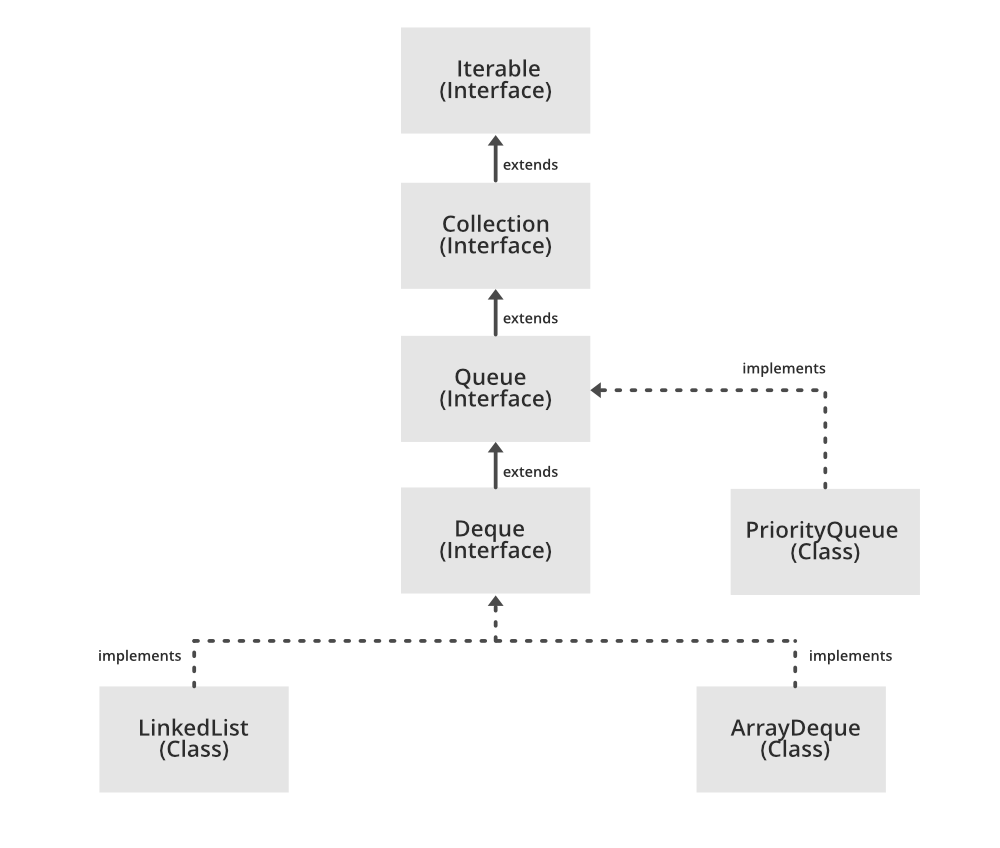
声明:
public class PriorityQueue<E> extends AbstractQueue<E> implements Serializable
其中 E 表示该队列中保存的元素类型
PriorityQueue的类型
- Max Priority Queue (最大优先队列)
- Min Priority Queue (最小优先队列)
默认优先队列示例
//默认PriorityQueue演示的Java程序
import java.util.*;

class PriorityQueueDemo {

    // 主方法
    public static void main(String args[])
    {
        // 创建空的优先级队列
        PriorityQueue<Integer> pQueue
            = new PriorityQueue<Integer>();

        // 使用add()方法向pQueue添加元素
        pQueue.add(10);
        pQueue.add(20);
        pQueue.add(15);
        pQueue.add(5);

        // 输出优先级队列的顶部元素
        System.out.println(pQueue.peek());

        // 输出并从PriorityQueue容器中删除顶部元素
        System.out.println(pQueue.poll());

        // 再次输出顶部元素
        System.out.println(pQueue.peek());
    }
}
输出
5
5
10
在Java中,PriorityQueue默认实现为min Priority Queue。如果需要从min到max Priority Queue更改Priority Queue的顺序,则可以使用以下方法:
- 使用默认Comparator Collections.reverseOrder()
- 使用自定义比较器
- 使用 lambda表达式
方法1: 使用默认Comparator Collections.reverseOrder()
使用Collections.reverseOrder()方法来获取默认比较器的相反行为。这是java.util包中的默认比较器。
示例:
// Java program to demonstrate the
// working of PriorityQueue in reverse order
import java.util.*;

class PriorityQueueDemo {

    // Main Method
    public static void main(String args[])
    {
        // Creating empty priority queue
        PriorityQueue<Integer> pQueue
            = new PriorityQueue<Integer>(
                Collections.reverseOrder());

        // Adding items to the pQueue using add()
        pQueue.add(10);
        pQueue.add(20);
        pQueue.add(15);
        pQueue.add(5);

        // Printing the top element of PriorityQueue
        System.out.println(pQueue.peek());

        // Printing the top element and removing it
        // from the PriorityQueue container
        System.out.println(pQueue.poll());

        // Printing the top element again
        System.out.println(pQueue.peek());
    }
}
输出
20
20
15
方法二:使用自定义比较器
The java.util.PriorityQueue.comparator() 方法共享了一个重要的作用,即设置并返回可用于对 PriorityQueue 中的元素进行排序的比较器。如果队列遵循元素的自然排序模式,则该方法返回 null 值。
示例:
// Java program to demonstrate the
// working of PriorityQueue in reverse order
import java.util.*;

public class PriorityQueueDemo {

   // Main Method
   public static void main(String[] args)
   {
       // Creating empty priority queue
       // with custom Comparator
       PriorityQueue pQueue
           = new PriorityQueue(
               new Comparator() {

                   // Compare method for place element in
                   // reverse order
                   public int compare(Integer a, Integer b)
                   {
                       if (a < b)
                           return 1;
                       if (a > b)
                           return -1;
                       return 0;
                   }
               });

       // Adding items to the pQueue using add()
       pQueue.add(10);
       pQueue.add(15);
       pQueue.add(20);
       pQueue.add(5);

       // Printing the top element of PriorityQueue
       System.out.println(pQueue.peek());

       // Printing the top element and removing it
       // from the PriorityQueue container
       System.out.println(pQueue.poll());

       // Printing the top element again
       System.out.println(pQueue.peek());
   }
}
输出:
20
20
15
方法三:使用 lambda 表达式
Lambda 表达式自 Java 8 以来就开始使用,lambda 函数将其输入参数命名为 a 和 b,并返回(b-a),这基本上就是 int 比较器类所做的,只不过它返回 a-b。
示例:
// Java program to demonstrate the
// working of PriorityQueue in reverse order
import java.util.*;

class PriorityQueueDemo {

   // Main Method
   public static void main(String args[])
   {
       // Creating empty priority queue
       PriorityQueue pQueue
           = new PriorityQueue((a, b) -> b - a);

       // Adding items to the pQueue using add()
       pQueue.add(10);
       pQueue.add(20);
       pQueue.add(15);
       pQueue.add(5);

       // Printing the top element of PriorityQueue
       System.out.println(pQueue.peek());

       // Printing the top element and removing it
       // from the PriorityQueue container
       System.out.println(pQueue.poll());

       // Printing the top element again
       System.out.println(pQueue.peek());
   }
}
输出:
20
20
15